To discuss
Businesses and marketing service companies tend to make this process sound complex. As if only they could heal your pain, then charge you the earth for it.
It is important to understand (and discuss) the product, the customer and the business views. As it is to conduct some parallel research.
What makes the services good is the level of trust you are able to build with your target audience. It is useful to start with the 4Ws: Who? What? When? Why? Or as they like to call it, to pinpoint the ideal client (or target audience). I think it should all be laid out more simply. No complicated strategies. You can do it too.
This checklist draws some action plans that you can go through and put in place now. A quarterly review is recommended. Focus on gently nurturing customer acquisition, return and retention. No rush. No forceful sales.
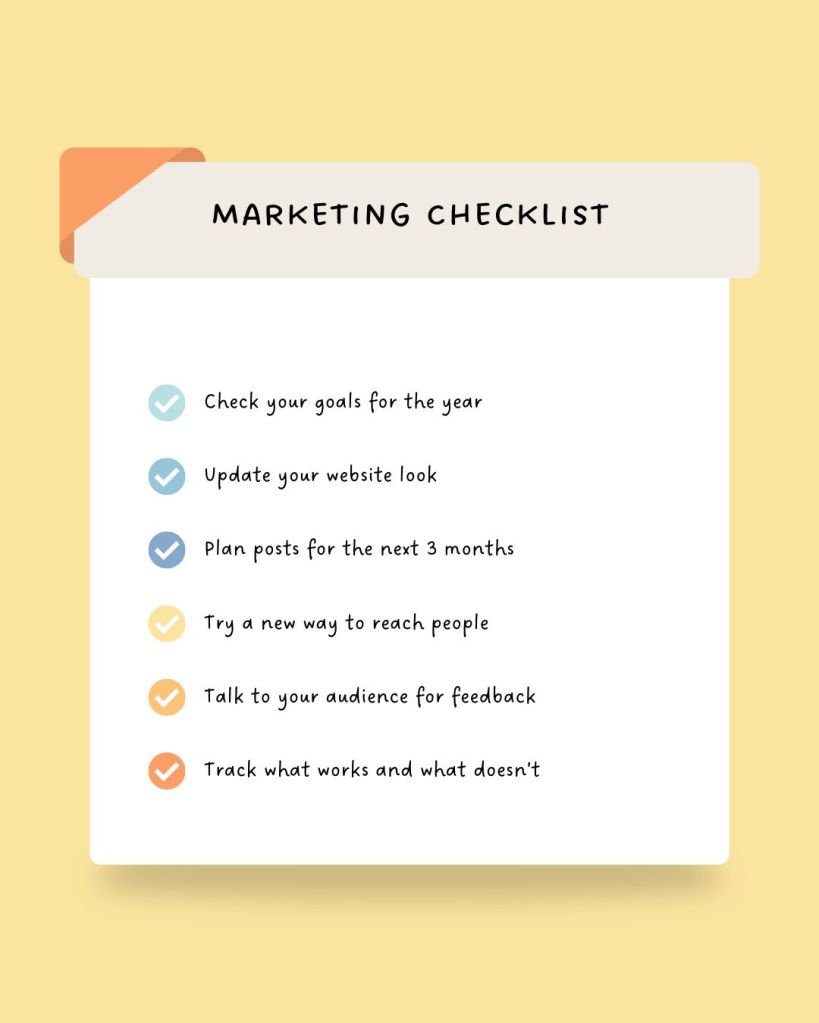
To brainstorm
People are starting to move away from the screens more. Which may allow businesses to regroup and think about recycling old school strategies.
The last few years have been a constant injection of fast-paced, tireless marketing services for companies, who are having to include hiring these services in their budgets. Some can be over the top. It’s like walking into the Aldi and Lidl middle aisle: you never needed any of that until you saw it.
Planning ahead of time is good, but if you’re planning for the year, keep it high-level, as it will require reviews. Quarterly regroups to see what strategy is working better, what needs removing, or what changes are needed.
You will find people who are interested in your product; you just need to find the right customers and the right way to appeal.
- Can you perhaps network and partner up locally?
- Would organising events or promotional offers fit your product?
- Maybe a trial subscription?
- An introductory offer?
- A referral scheme?
And you can shout these out digitally. But which ones suit which format, and what other useful information can you share that is helpful and helps build trust over time. But keep it to a minimum, unless your customers request it.
Blog, Email or Newsletter?
It really depends on what you sell and how much your audience wants to hear from you.
You can also apply them in a cross-functional way, ie include links to a blog in an email or newsletter. The newsletter can be distributed as the body of an email or attached to an email in another format.
A blog intends to share a story or a personal (or business) view. You can use it to promote a product (or several). It can be used for reviews, tips, recommendations, tutorials, etc.
The general rule of thumb is that emails are good for updates. Depending on the nature of your business, it can serve to share a product launch, that a product has been discontinued, that there were changes to the terms and conditions, or to notify customers that a reservation/appointment got cancelled. You can also use email series with a purpose (or several). You can have one simple purpose, ie offer a 10-Email Series where you share your ten best-selling products (and a discount offer), or ten case studies or customer stories, or ten last-minute unfallible recipes. Ideally, these are more effective if you can monitor the opening and conversion rates to understand if they are effective.
A newsletter will go out more sporadically, ie once a week or once a month. It should contain news about the business or products, updates, promotions, or other valuable information, such as the latest customer reviews.
Needless to say, all of the above should be complemented with appealing imagery (photo or video).
Check these out 👇👇👇
Déjà Done
(or most commonly known as “Portfolio“)
 Nostalgic Mumma